
Sex Offender Checks in Camp County
The Texas Public Sex Offender Registry is the main public source for a Camp County sex offender search. Texas DPS maintains the statewide database under Code of Criminal Procedure Chapter 62. The county government does not publish a separate Camp County offender map or local registry list, so the state tool is the practical starting point. Search by more than one route when a result matters to a family or neighborhood safety plan.
A name search can identify a known person. County and address searches answer a different question: which public registrations fall within Camp County or near a given place? Results should be compared by name, physical details, status, address, offense, and registration authority. Similar names alone are not enough. The registry is a public-notification record, not a live tracking system.
Camp County and Pittsburg Registry Searches
Search Camp County and Pittsburg separately. The county filter can capture public registrations outside the city, while a Pittsburg filter narrows the result set tied to the city label. This two-pass method matters because “Pittsburg” can appear as a postal address beyond the municipal boundary. A city-only query may therefore omit a rural Camp County registration that is still close to the place being checked.
Begin wide, then narrow. Use Camp as the county, review the list or map, and repeat with Pittsburg or a precise street address. For Rocky Mound and other rural parts of Camp County, rely on the county and address tools instead of assuming the city field reflects legal boundaries.
Note: Postal labels help deliver mail, but they do not decide which Camp County law-enforcement office serves as the registration authority.
How to Search the Texas Public Sex Offender Registry
The Texas DPS search offers both identity and location paths. Use the controls that match the question, and avoid adding filters that could screen out a relevant Camp County record. Exact radius choices and the portal's treatment of partial names can change, so read the live control labels before submitting.
- Open the official DPS registry and review its public-use terms before entering search data.
- Search by last name and optional first name, or choose Camp County, Pittsburg, ZIP code, or an address.
- Compare the list and map results, then open a candidate profile instead of relying on the summary row.
- Read the registered address, status, registration authority, offense, duration, and physical details together.
| Field label | Type | Required | Use in Camp County |
|---|---|---|---|
| Last Name | Text | Name-search key | Use a legal surname; check live rules for partial names |
| First Name | Text | Optional | Narrows a common surname |
| County | Dropdown | Optional | Select Camp for a countywide search |
| City | Text or dropdown | Optional | Use Pittsburg, but do not exclude rural Camp |
| ZIP Code | Text | Optional | Narrows by postal area, not municipal border |
| Address and Radius | Text and dropdown | Address-search path | Checks proximity around a street location |
| Map/List View | Control | Optional | Switches between geographic and tabular results |
Search and Clear controls submit or reset the form. Once a likely Camp County record appears, use the profile rather than the map marker as the main source for public facts.
Camp County Registry Address and Radius Search
The official registry search interface illustrates how Texas DPS brings name, county, city, address, and map controls into one public system.
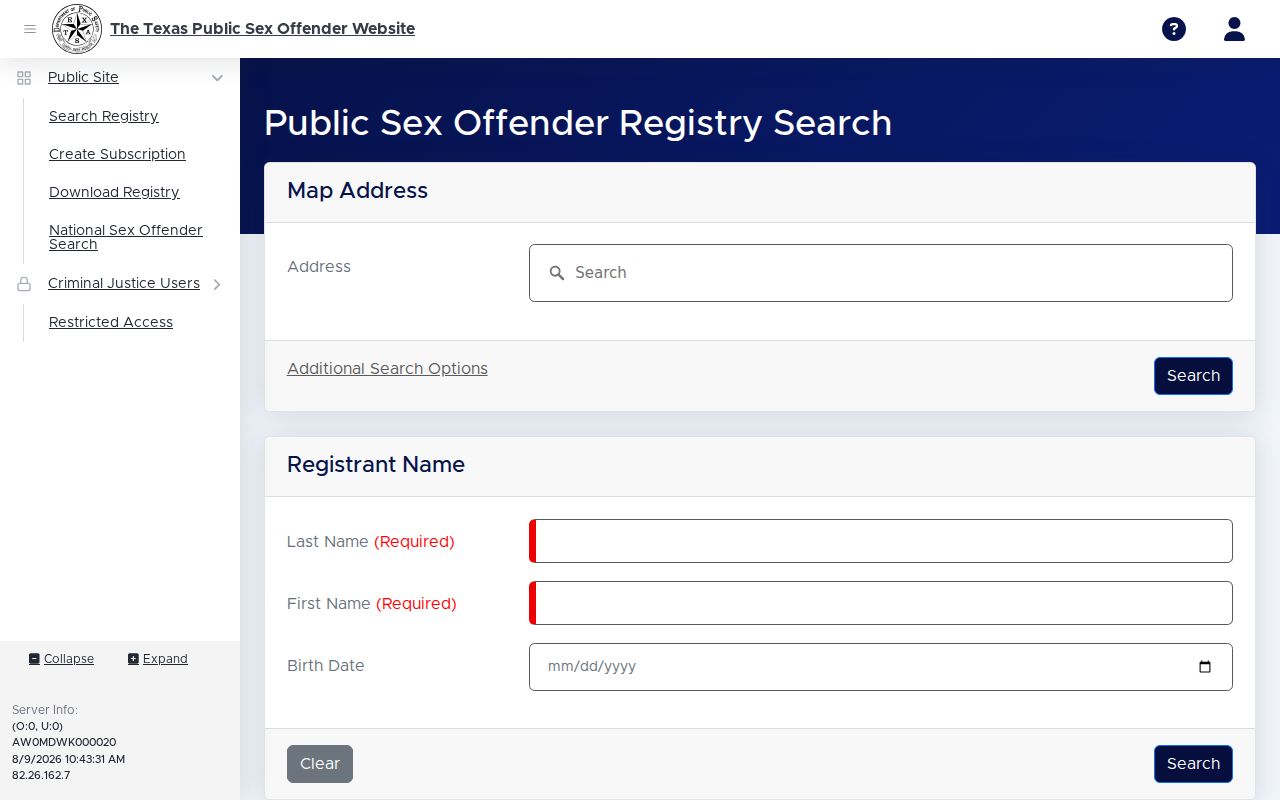
The search screen supports a useful Camp County pattern: run a countywide query first, then an address-and-radius search around the location that matters. A school, park, home, or meeting place may sit near a boundary that a city filter does not reflect.
Geographic results need care. A plotted point reflects the registered address held in the public record, not a promise that the registrant is standing there now. Radius output is a search aid, not legal advice about property lines or any restriction that may apply to one location. Check the profile date and authority, then report a suspected error through official channels.
Inside a Registry Profile
A Texas public profile combines identity clues, the registered location, the reportable offense, and the person's current registration framework. The most useful reading method is cross-field comparison. A photo or name by itself can mislead; aliases, physical descriptors, DPS number, status, authority, and offense details help distinguish records.
| Name and aliases | Registered name, other reported names, and the DPS identifier |
|---|---|
| Photo and description | Photograph, sex, race, age information as displayed, height, weight, hair, eyes, and identifying marks |
| Registered address | The public Camp County location and the authority that maintains the local registration |
| Offense information | Offense description or statute, conviction or adjudication date, and public victim age or sex category when allowed |
| Risk and duration | Assigned risk level when present and a registration end date or lifetime indicator |
| Status and added fields | Registration status, physical markers, and vehicle information for registrations where law makes it public |
Open the complete Camp County profile even when a list row appears to match. The detail view supplies the context needed to interpret the record and identify the correct local authority.
Camp County Public Registry Profile Limits
Public access has firm limits. DPS does not release a registrant's Social Security number, driver's-license number, telephone numbers, online identifiers, employer contact details, victim identity, or fields that Chapter 62 keeps nonpublic. Some juvenile information may also be withheld by court order. A missing field is not proof that DPS failed to collect it.
The Texas DPS registration program overview explains the state's registration and public-notification role.
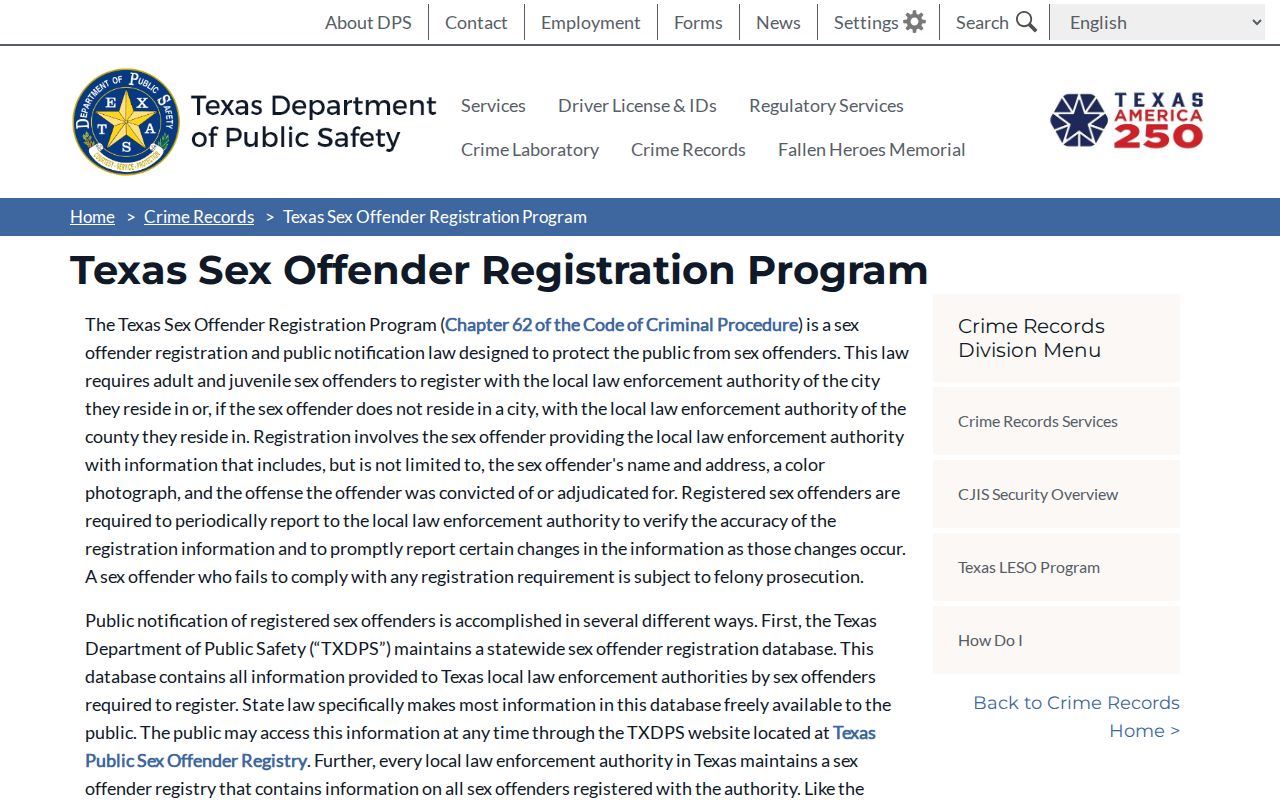
The program material helps separate data held for administration from the smaller set placed on a Camp County public profile. Searchers should not try to infer hidden facts from a blank public field.
Texas Registration Levels and Requirements
Texas does not use a simple federal Tier I, II, and III chart as the controlling public framework. Chapter 62 applies offense-based lifetime or ten-year duties, while risk assessment categories can affect public notice. Verification is generally annual unless a statute calls for more. Civil commitment, high-risk status, juvenile orders, and an obligation imposed by another jurisdiction can change how the rule operates.
| Texas category | General duration | Verification note |
|---|---|---|
| Adult sexually violent and other listed lifetime offenses | Life | Frequency may increase for civilly committed or high-risk categories |
| Other adult reportable convictions or adjudications | Until the tenth anniversary after the latest release, discharge, or court discharge | Generally annual unless Chapter 62 requires more |
| Juvenile adjudication-based registration | Generally the tenth anniversary after disposition or completion, whichever is later | A court can affect public status and duties |
| Extrajurisdictional registration | Period required by the originating, federal, or military law | The Texas registration authority administers the local duty |
A Camp County profile should be read under the category it actually displays. Risk level and term of registration answer different questions, so one should not be substituted for the other.
Camp County Registry Map Limits
A Camp County registry map is a snapshot of recorded addresses. It is not a real-time presence report. People move, offices process updates, and postal labels can differ from municipal geography. A point close to a boundary also does not resolve the legal status of a particular parcel or prove a breach of any rule.
Use the map to identify profiles worth reading. Then compare the registered address, profile status, and registration authority. If the location seems stale or wrong, preserve the public record details and contact that authority. Do not visit the address to investigate. Direct observation can be mistaken, and confrontation can create danger or violate the law.
Note: A blank map area means only that the selected public query returned no plotted record, not that every person nearby was screened.
Camp County Registry Postcard and School Notices
Chapter 62 provides more than online publication. For specified high-risk or civilly committed arrivals, local notice can include postcards within a one-mile area that is not subdivided or within three blocks in a subdivided area. Certain school notifications can also apply. These measures depend on the statutory category and location; they are not automatic for every Camp County registry entry.
The local authority maintains registration and sends the information into the statewide system. That division of work explains why a resident may receive notice from a local office while the searchable profile appears on DPS infrastructure. A postcard is tied to statutory notification rules, while the online Camp County search remains open to the public at large.
Camp County Registry Search Beyond Texas
A Texas search stops at the state's public system. The National Sex Offender Public Website, operated by the U.S. Department of Justice, adds a cross-state layer when a person or address has ties outside Texas.
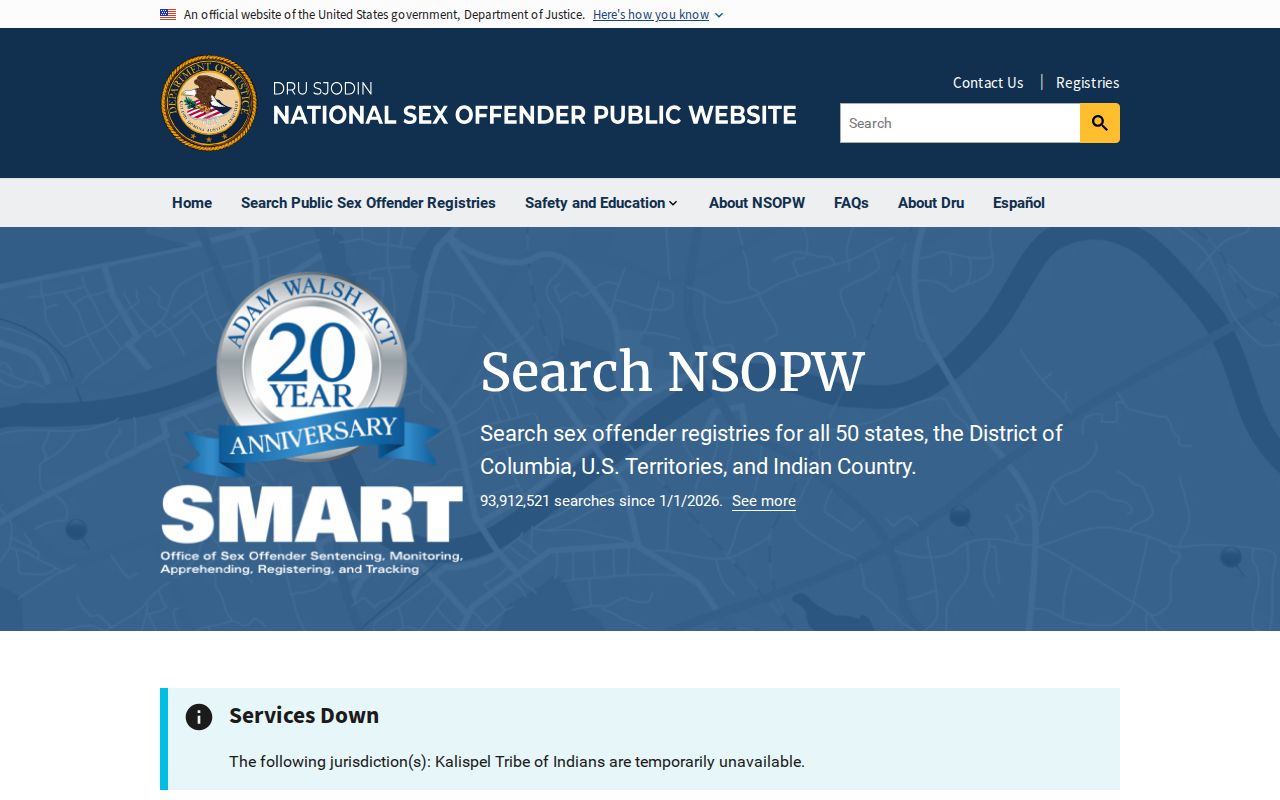
NSOPW is best used as a supplement, not a replacement. Return to the Texas DPS profile for Texas-specific fields, the registration authority, and the public details maintained under Chapter 62. Different jurisdictions publish different fields and update through their own agencies, so the national result should route a reader back to the source registry.
Reporting Camp County Registry Noncompliance
Suspected noncompliance belongs with law enforcement. Use the registration authority shown on the profile when possible. For an address outside a municipality, contact the Camp County Sheriff at 903-856-6651. The county government directory provides the official local-office route when assignments change. For a Pittsburg municipal registration, confirm the current city police channel. DPS can also receive questions about the statewide record and the Texas Sex Offender Registration Program.
If suspected noncompliance later becomes a filed felony case, its court record moves to the Camp County District Clerk. The original registry report still belongs with law enforcement, not the clerk.
Give the agency the profile identifier, registered address, the specific discrepancy, and when it was observed. Stick to facts. Do not publish accusations, follow anyone, or confront a registrant. A map mismatch may stem from timing, boundary labels, or a move already being processed. The authority can compare the report against records that are not public and decide whether an inquiry is warranted.
Community Notification and Lawful Use
Camp County registry information supports personal, family, and community awareness. It can help residents recognize the scope of a public record, review nearby registrations, and choose ordinary safety steps. It does not authorize private enforcement. A public profile should be checked for status and source, shared with care, and reported through the correct registration office when something appears wrong.
Use registry information lawfully: Texas Code of Criminal Procedure Chapter 62 governs registration and public notice. Misusing registry data to harass, threaten, stalk, damage property, interfere with registration, or commit another offense is unlawful and may be a crime under Texas law.
Safety concerns that call for an official response should go to law enforcement. A Camp County search result is a government record for awareness, not permission to punish, pressure, or expose a registrant's household.