
Checking Criminal History in Pittsburg
A sound Pittsburg criminal records search begins with the kind of event involved. Pittsburg Police is the likely creator of a city offense or arrest narrative. Municipal Court is the first court route for a city ordinance, traffic citation, or other fine-only matter within its jurisdiction. A felony file goes to the Camp County District Clerk, while a Class A or B misdemeanor generally goes to the County Clerk. The Camp County Sheriff holds local jail and booking material. For a broader Texas result, DPS maintains the statewide repository, but its public name product does not replace those local files.
Use enough detail to distinguish the record without sending sensitive identifiers to an unverified service. A report number, citation number, approximate date, location, and correct name can narrow the request. Then ask the custodian for the record it actually holds.
- Ask Pittsburg Police or the current city records custodian for a city incident or arrest report.
- Use a written Texas Public Information Act request when the record is not offered through a public portal.
- Check Pittsburg Municipal Court for a citation or fine-only city case, using the case number when known.
- Move to the Camp County Sheriff and the correct county clerk for booking data and filed prosecutions.
- Use the Texas DPS name search or fingerprint self-review for the statewide layer that fits the purpose.
Confirm each match at its source. Pittsburg criminal records can share names, and a name-only DPS hit is not fingerprint proof of identity.
Four Pittsburg Criminal Record Counters
Pittsburg is the county seat, so several Camp County record routes are concentrated in town. The offices are close in geography but not interchangeable. The District Clerk in Room 204 of the Camp County Courthouse holds felony cases from the 76th and 276th District Courts. The County Clerk in Room 102 holds constitutional County Court misdemeanor files. The Justice of the Peace works from 115 Dr. Martin Luther King Jr. Avenue, Suite C, for county fine-only matters. The Sheriff and jail operate at 203 Tapp Street for booking and custody material.
| Pittsburg record need | Verified route | Useful locator |
|---|---|---|
| Felony court file | District Clerk, Room 204 | Cause number, name, filing year |
| County misdemeanor | County Clerk, Room 102 | Cause number, name, date range |
| County fine-only case | Justice of the Peace counter | Citation or case number |
| Booking or jail record | Camp County Sheriff | Booking number, name, arrest date |
Both courthouse clerks publish a lunch closure and split weekday hours, with a shorter Friday afternoon. Call before an in-person Pittsburg records trip, especially when the cause number is unknown or a certified copy is needed.
Pittsburg Police Department Records
Pittsburg Police creates reports for incidents and arrests handled by its officers. The research did not locate a stable official police records page, public request form, direct records-desk listing, or city police app. That makes a direct city inquiry and a written request the practical route. Ask the city to identify the current custodian for Pittsburg Police records. Describe the incident number, date, time, place, desired record type, delivery format, and a cost ceiling. If body-camera video or 911 material is sought, identify the event with care because large files, retention limits, and redactions may affect release.
The Camp County Sheriff is not a substitute for the Pittsburg Police narrative. The sheriff may hold the jail booking sheet after a Pittsburg arrest, yet the city police report stays with the agency that created it. In the other direction, Pittsburg Police should not be expected to provide the final county judgment. That belongs to the clerk once a prosecutor files the charge.
Under the Texas Public Information Act, a request may seek existing public records without special wording. Pittsburg may release public parts, redact confidential fields, or seek an Attorney General decision when an exception is claimed. Ask for releasable basic information if investigative detail is withheld.
Pittsburg Criminal Records Without a Blotter
No official Pittsburg arrest blotter or city booking gallery was found. That absence does not establish that no arrest occurred. It only means a reader cannot rely on a city web list. A person may have been cited and released, booked at the county jail, transferred, housed outside Camp County, or released before a custody check. For a recent event, pair a Pittsburg Police request with a sheriff custody inquiry and then watch for a new clerk cause number.
The official county government site shows why the local routes remain separate. The Camp County department directory is a starting point for the sheriff and clerk offices that receive later parts of a Pittsburg case.

The directory image supports a source-first search: identify the office that owns the desired Pittsburg record, then verify its current contact channel before submitting private data.
Commercial people-search and booking sites do not fill this official gap. They may omit dismissals, repeat stale data, or attach a record to the wrong person. Use government custodians for the underlying document.
Pittsburg Arrests and Bookings
A Pittsburg arrest can produce several files in quick succession. The officer creates the arrest report and probable-cause material. The booking office records intake, fingerprints, initial charges, bond, property, and custody status. A magistrate records warnings, probable-cause findings, and bond decisions. The prosecutor may later reject, narrow, raise, or replace the first charge. Because each record freezes a different stage, the initial booking label should not be treated as the final court result.
Call the Camp County Sheriff at 903-856-6651 for current local booking and location questions. The verified sheriff address is 203 Tapp Street, Pittsburg, Texas 75686. Ask whether the person remains there or was housed elsewhere. The county site does not publish a booking roster, a separate jail information line, or a fixed report fee, so request a quote and the required request format before copies are made.
For deeper county-wide arrest access, the Camp County arrest lookup explains the full custody and report chain. A Pittsburg city search should stay focused on the city report, the booking location, and the filing court.
Note: An arrest is an allegation-stage event and does not prove that Pittsburg prosecutors filed the same charge or won a conviction.
VINELink for Pittsburg Booking Records
The Camp County Sheriff points custody searchers to VINELink. It can help locate a participating custody record and supports notifications, but it is not a Pittsburg criminal history database. A blank response may reflect spelling, release, transfer, delayed data, or the limits of participating feeds. Call the sheriff after an inconclusive result and ask where the person is physically held.
Pittsburg records users should also distinguish present custody from court history. VINELink does not supply the police narrative, prosecutor decision, docket, judgment, or complete statewide arrest cycle. Once a charge is filed, the county clerk with jurisdiction becomes the better source for status and disposition. If a state sentence follows, the TDCJ Online Inmate Search becomes the correct custody system rather than the local channel.
The county budget funds a small jail staff and has included inmate-housing lines. That context supports a practical rule: confirm location instead of assuming every Pittsburg arrestee remains at 203 Tapp Street.
Municipal Court Records in Pittsburg
Pittsburg Municipal Court handles city ordinance matters and fine-only state-law offenses that fall within municipal jurisdiction. It is not the Camp County Court and does not hold felony cases. The research found no verified public municipal docket portal, so use the current court counter or telephone process identified by the city. A citation or case number is the best locator. If it is missing, provide the name, the violation date, and the issuing agency, plus birth data only when the court lawfully asks for it.
| Court Name | Pittsburg Municipal Court |
|---|---|
| Case Types Heard | City ordinances, traffic matters, and fine-only state-law offenses within municipal jurisdiction |
| Case Lookup Channel | Current municipal clerk telephone or counter route; no verified public case-search portal was located |
| What to Request | Charge, plea, judgment, balance, warrant or capias status, and next setting |
| Best Locator | Citation or case number, followed by name, violation date, and issuing agency |
Do not send payment or identity data through an unverified third-party page. Confirm the current Pittsburg Municipal Court channel with the city, and use the issuing court printed on the citation when there is any doubt.
When Pittsburg Records Have No Case
A police report can exist before a court cause number appears. Pittsburg Police may have completed an incident or arrest report while a prosecutor is still reviewing the facts. The District Clerk or County Clerk can correctly report no filed case at that moment. That answer does not erase the city report, settle the charge, or prove that filing will never occur. Keep the report number and ask which prosecutor or clerk would receive the matter based on the apparent offense level.
If a case later appears, compare its charging instrument with the initial Pittsburg arrest entry. Prosecutors may file a different charge, and a grand jury may indict or return no bill. The court file then becomes the source for the plea, motions, disposition, and sentence. The DPS repository depends on later agency and court reports, so it may lag behind the clerk.
- Initial charge
- The offense recorded when the arrest or citation was made; it can change.
- Cause number
- The clerk's identifier for a filed court case.
- Disposition
- The recorded result of a charge, such as dismissal, acquittal, deferred adjudication, or conviction.
- No bill
- A grand jury decision not to indict the charge presented to it.
These terms help keep Pittsburg police activity distinct from the outcome that a court later records.
Where Pittsburg Records Go
Pittsburg criminal records move by function, not as one complete file. Pittsburg Police retains its incident and arrest material. A local booking creates sheriff jail records. The proper prosecutor decides whether to file, and the District Clerk or County Clerk records the case at the level with jurisdiction. Municipal Court keeps its own fine-only docket. Reportable arrest, prosecution, and disposition events are then supposed to reach the Texas Department of Public Safety Crime Records Division.
Record flow: Pittsburg Police Department › Camp County Courts › Texas Department of Public Safety
The flow is useful, but it is not self-correcting. A Pittsburg police report can be current while the clerk has no case. A clerk judgment can be final while the DPS cycle lacks its disposition. Search the city source for the event narrative, the court source for the filed result, and DPS for the state repository view. For the broader division among record types, use the Camp County criminal history overview.
Pittsburg Criminal Records Across Eras
Pittsburg has long been the center of Camp County recordkeeping. The Texas State Library documents historic Camp County clerk records on microfilm, including District Clerk civil case papers beginning in 1874 and civil minutes beginning in the same period. Those exact holdings are civil, not proof that a named criminal file is on a reel. They still show why an older Pittsburg search may start with an index and clerk inquiry rather than a modern name box.
The Texas State Library Camp County inventory shows the archive arrangement behind that process.
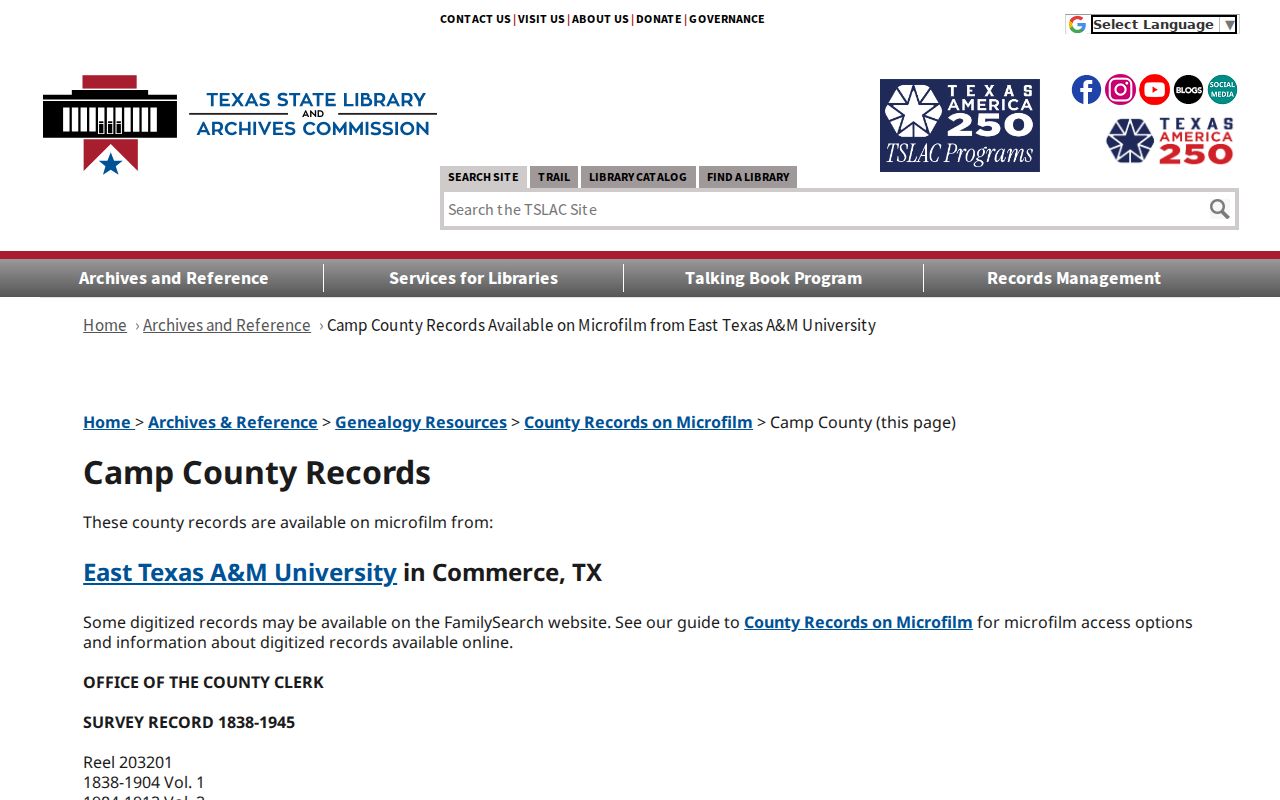
The inventory gives Pittsburg researchers a way to ask precise questions about dates, indexes, and reel references while confirming criminal holdings with the responsible clerk.
Modern tools such as re:SearchTX and DPS name search cover different parts of the system and do not guarantee complete historic Camp County images. For older Pittsburg criminal records, ask the clerk what index survives, where it is stored, and whether inspection or a copy can be arranged.
Pittsburg Criminal Record Reporting Gaps
A January 2025 DPS completeness extract assigned nine 2024 charges, one prosecution action, and no court action in the displayed columns to Pittsburg Police. Those figures measure the flow of reportable events into the computerized criminal history system. They are not a Pittsburg crime count, a full arrest total, or proof that no court resolved a case. The narrow meaning matters most: later stages were missing from the repository extract for some locally reported cycles.
When a Pittsburg DPS result has no court disposition, obtain the cause number and final document from the correct Camp County clerk. For one's own record, DPS provides a fingerprint record-review and challenge process. Certified court papers can support a correction, but the clerk cannot directly rewrite DPS data and DPS cannot create a local judgment that was never reported.
Do not read a blank field as a dismissal. Verify the court file, then treat the repository as a separate record that may need an update.
Public Access Rules in Pittsburg
Pittsburg police and court access follows Texas law, but public does not mean every detail must appear online. The Texas Public Information Act permits requests for existing local government records. Law-enforcement material may be withheld under an applicable exception, while releasable basic offense and arrest information has a distinct status. Juvenile, victim, medical, driver, and personal identifier fields may be confidential or redacted. Court clerks provide filed public material under their own access and copy procedures.
Key Statutes:
Texas Government Code Chapter 552 gives the public a route to existing government information unless it is confidential or excepted.
Texas Government Code Section 411.135 authorizes public access to specified conviction and deferred-adjudication information maintained by DPS.
Texas Code of Criminal Procedure Chapter 55A governs expunction of qualifying arrest records.
A narrow Pittsburg request works best. Name the producing agency, event, date range, and desired format. The office need not answer legal questions or create a new report. If material is withheld, ask which law controls the decision and whether segregable public portions can be released.